Special Webinar (August 2026)
From Postdoc to Leader Webinar Series
Guest Speaker: Professor Tareq Al-Naffouri
-
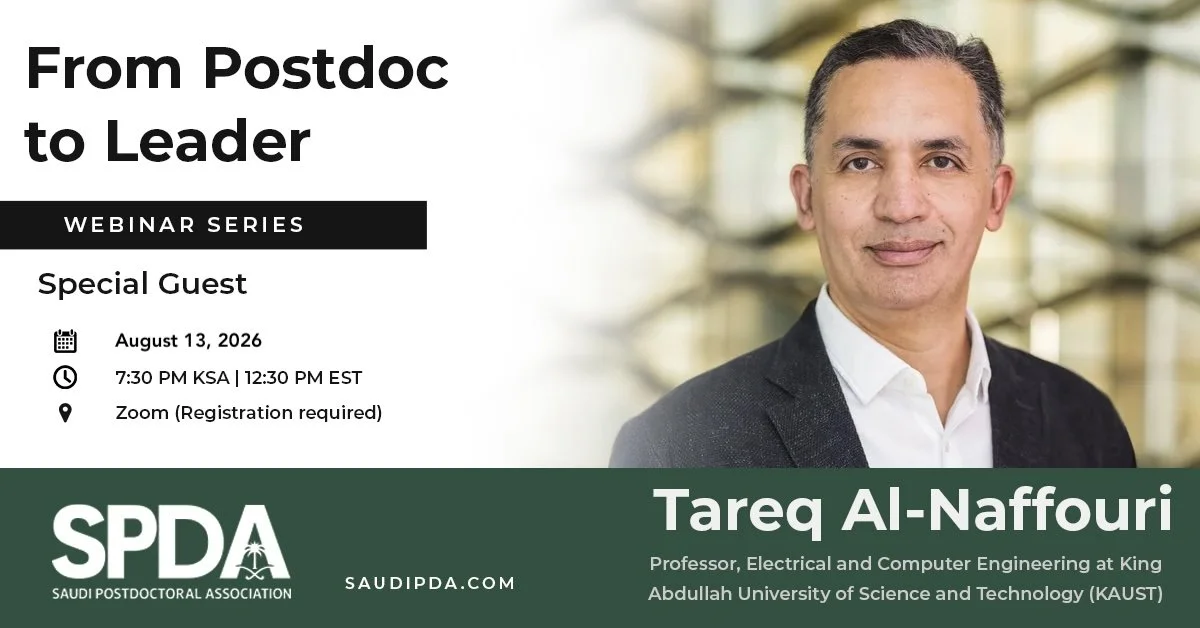
We are excited to invite you to the next session of the Saudi Postdoctoral Association (SPDA) webinar series, From Postdoc to Leader, featuring Professor Tareq Al-Naffouri.
In this session, Professor Al-Naffouri will join us for a conversation about his academic and leadership journey, sharing reflections from his research career, mentorship experience, and path toward building an impactful academic profile. He will discuss lessons learned, key transitions, and perspectives that may be helpful for postdoctoral researchers as they navigate their own careers.
The session will also provide an opportunity for attendees to engage directly with Professor Al-Naffouri through an open Q&A and audience discussion.
-
Tareq Al-Naffouri is a professor in the Electrical and Computer Engineering (ECE) Program at King Abdullah University of Science and Technology (KAUST).
Al-Naffouri earned a B.S. (Hons.) in Mathematics and Electrical Engineering from King Fahd University of Petroleum and Minerals, Saudi Arabia,
During the summers of 2005 and 2006, Al-Naffouri was a visiting scholar at the California Institute of Technology, U.S. He was a Fulbright Scholar at the University of Southern California, U.S., in 2008.
An IEEE Senior Member, he has produced over 370 publications in journals and conference proceedings and 24 issued/pending patents. Al-Naffouri received the IEEE Education Society Chapter Achievement Award (2008), the Almarai Award for Innovative Research in Communication (2009) and the Abdul Hameed Shoman Prize for Innovative Research in IoT (2022).
SPDA Technical Webinar (July 2026)
Guest Speakers:
Dr. Sharifa Alghowinem
Dr. Feras Moria
-
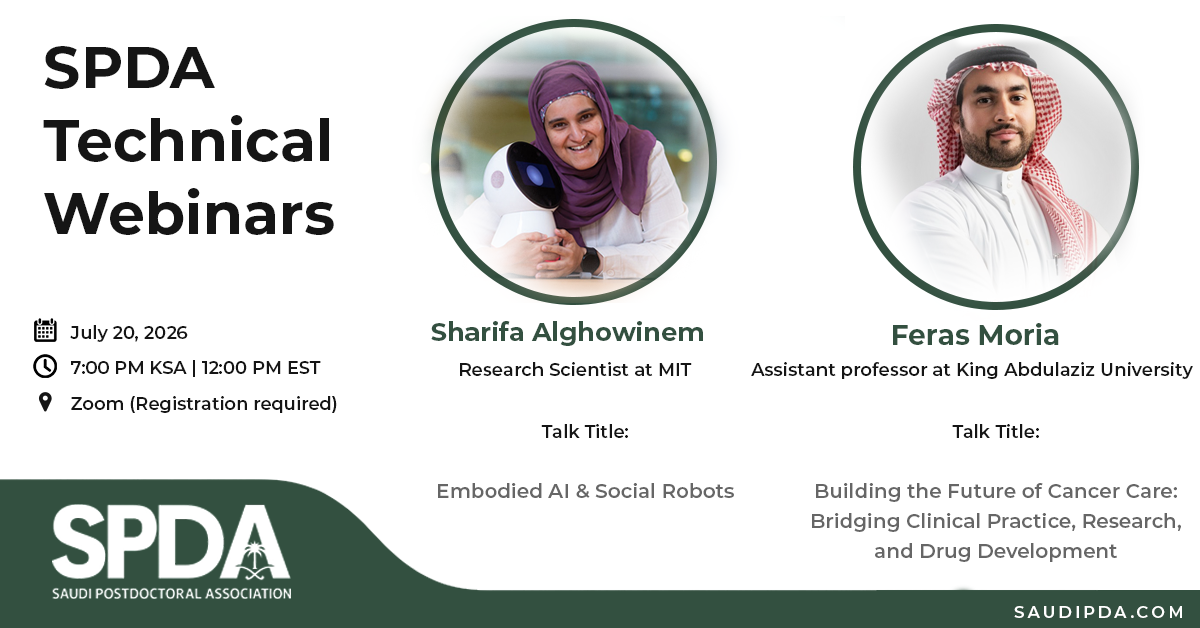
Dr. Sharifa Alghowinem is a research scientist at MIT's Personal Robots Group, where she develops AI models for enhanced human-robot interaction. She holds a PhD in multimodal AI from the Australian National University (2015), an MSc in Software Engineering from the University of Canberra (2010), and a BSc in Computer Applications from King Saud University (2004). Her research focuses on mood and behavior recognition using speech, gaze, and body movement to detect conditions such as depression, suicide risk, and deception. She is also Associate Director of Postgraduate Programs at Prince Sultan University, with eight years of teaching experience in computer science and AI.
-
Embodied AI & Social Robots
Abstract:
How can a robot understand not just what we say, but how we feel? How can the robot respond back with social cues that increase trust and rapport for optimal benefits? This talk explores embodied AI for social robots, from multimodal models that understand human behaviours through speech, gaze, and body language, to companion robots like Jibo that respond with empathy across languages and cultures, including Arabic. Drawing on postdoctoral work at MIT's Personal Robots Group, I will share applications in emotional wellness coaching, medication adherence, and supporting Arabic-speaking children, alongside the foundational multimodal AI research behind them.
-
Dr. Feras Moria is an assistant professor of Medicine at king Abdulaziz University and consultant medical oncologist, king Abdulaziz university hospital
He completed my Internal Medicine and Medical Oncology training at McGill University, followed by advanced fellowships in Breast Oncology, Genitourinary oncology and Phase I Clinical Trials, at the McGill University Health Centre in Montreal, Canada.
His academic interests focus on early-phase clinical trials, translational oncology, precision medicine, and real-world evidence. He is leading and collaborating on multiple international clinical research initiatives and actively involved in establishing early drug development and Phase I clinical trial programs in Saudi Arabia. Alongside his clinical and research activities, he is committed to medical education and mentoring the next generation of physicians.
-
Building the Future of Cancer Care: Bridging Clinical Practice, Research, and Drug Development
Abstract:
Advances in cancer care are transforming patient outcomes at an unprecedented pace, driven by innovations in translational research and clinical trials. Behind every targeted therapy, immunotherapy, and antibody-drug conjugate lies a rigorous process that translates scientific discoveries into treatments capable of changing patients’ lives.
This talk will explore that journey through the perspective of a medical oncologist actively involved in clinical care, clinical trials, and early drug development. Participants will gain an overview of how promising laboratory discoveries progress through early- and late-phase clinical trials before becoming standards of care, while highlighting the collaborative roles of clinicians, scientists, industry partners, and regulatory teams in advancing cancer therapeutics.
Drawing from personal training and experience in oncology and clinical research, the session will also discuss career pathways that integrate patient care with research and innovation. Finally, the talk will highlight emerging opportunities for translational oncology and early drug development in Saudi Arabia, and how the next generation of healthcare professionals and researchers can contribute to shaping the future of cancer care.
SPDA Technical Webinar (May 2026)
Guest Speakers:
Dr. Lamyaa Almehmadi
Dr. Saud Alomairah
-
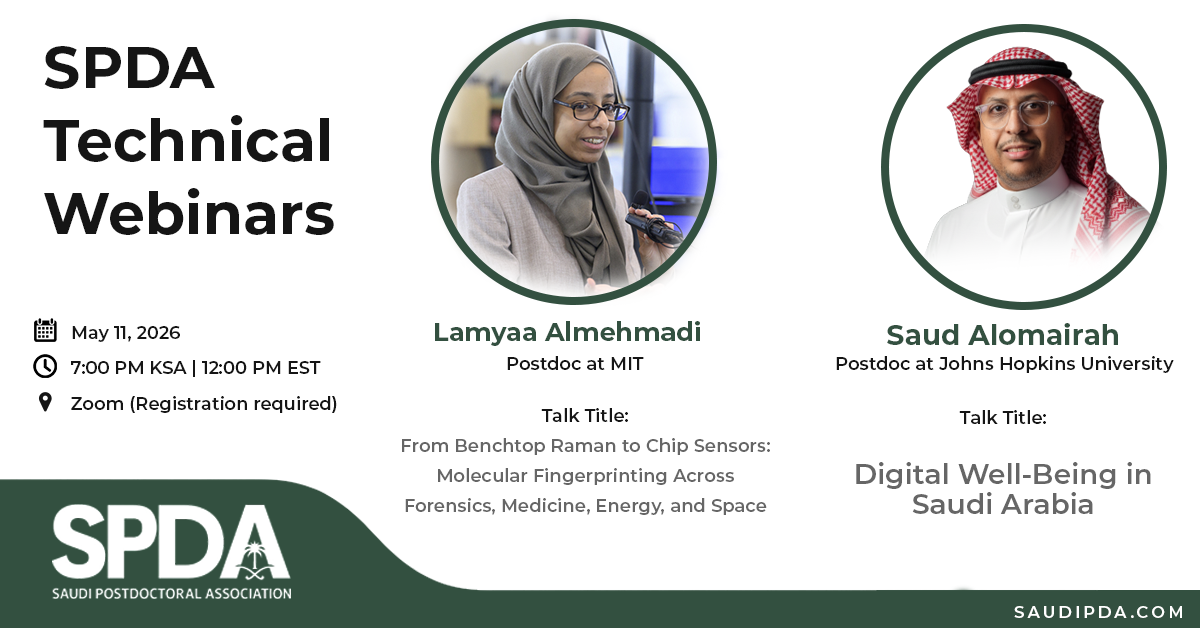
Dr. Lamyaa Almehmadi is a postdoctoral researcher at MIT working on Raman spectroscopy for molecular sensing. Her research spans single-molecule detection, portable Raman systems, and semiconductor chip-based sensors, with applications in medicine, forensics, and energy. She focuses on translating spectroscopy from laboratory instruments into deployable technologies, including integration with robotics for real-time chemical analysis. She is broadly interested in leveraging Raman spectroscopy as a universal tool to solve complex analytical challenges across scientific, industrial, and field environments
-
From Benchtop Raman to Semiconductor Chip Sensors: Molecular Fingerprinting Across Forensics, Medicine, Energy, and Space
Abstract:
Raman spectroscopy provides a powerful, non-destructive approach for molecular fingerprinting across diverse environments. In this talk, I present a multi-scale framework that translates Raman technologies from benchtop instruments to portable systems and semiconductor chip-based sensors. At the fundamental level, I explore single-protein and single-molecule detection enabled by enhanced Raman techniques. Building on this foundation, I develop deployable platforms for applications in forensics, medical diagnostics, drug discovery, and energy monitoring. Finally, I highlight the use of of chip-scale Raman sensors and robotic integration for real-time, in situ chemical analysis, enabling scalable and autonomous molecular sensing from the laboratory to the field.
-
Dr. Saud Alomairah is a postdoctoral fellow at the Johns Hopkins Bloomberg School of Public Health. His research focuses on digital health, behavioral interventions, and population wellbeing. He works on projects examining adolescent digital media use as well as maternal health and physical activity, including the use wearable technologies to monitor activity during pregnancy. His work integrates behavioral science, digital tools, and public health interventions to improve health outcomes
-
Digital Well-Being in Saudi Arabia
Abstract:
Adolescents today are growing up in a highly connected digital environment where online engagement is part of everyday life. While digital technologies offer many benefits, excessive screen use has been associated with sleep disruption, reduced physical activity, and poorer mental well-being among young people. Addressing these challenges requires coordinated strategies that involve schools, families, and communities. This presentation will describe the development and evaluation of a culturally tailored digital wellbeing intervention for adolescents in Saudi Arabia. The project used a multi-stage approach that included stakeholder engagement with teachers, parents, and community leaders, as well as formative research to understand local perspectives on technology use and adolescent wellbeing. Based on these insights, a school-based intervention was designed that combines a digital wellbeing curriculum delivered in classrooms with complementary components aimed at strengthening the broader support system around students. These include a four-week WhatsApp-based engagement program for parents and brief online training modules for teachers delivering the curriculum. The effectiveness of the intervention is being evaluated through a cluster-randomized controlled trial conducted in high schools. The study examines changes in adolescents’ leisure screen time as the primary outcome, along with secondary outcomes including physical activity, sleep, and mental wellbeing. This project aims to provide evidence on scalable strategies to promote healthier digital habits among adolescents.
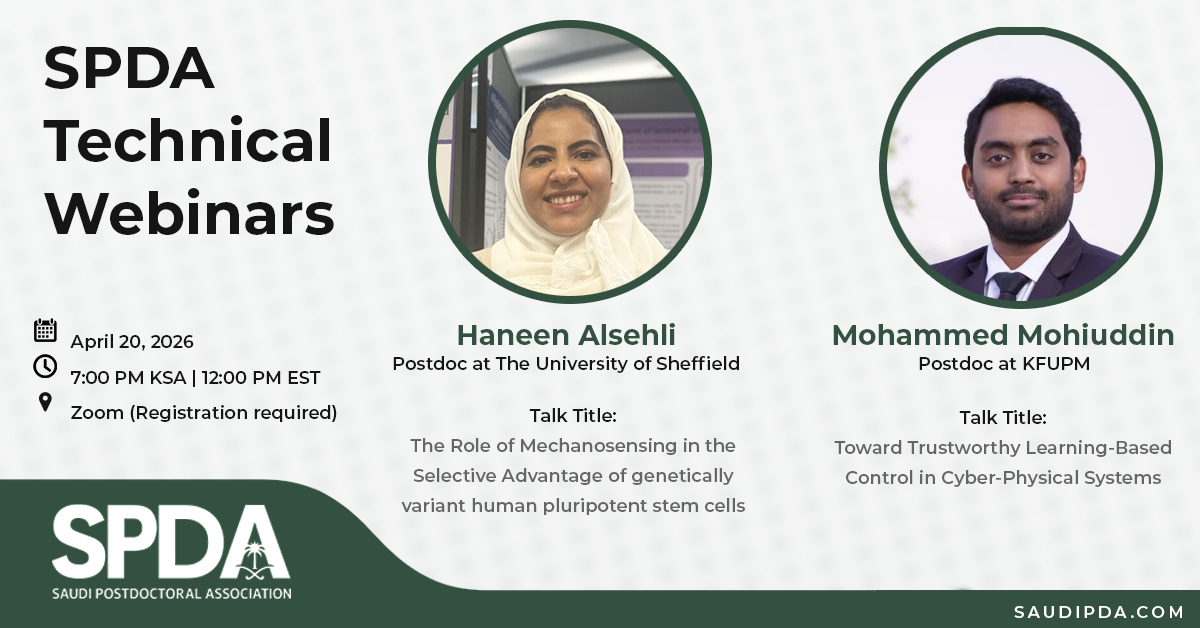
SPDA Technical Webinar (April 2026)
Guest Speakers:
Dr. Haneen Alsehli
Dr. Mohammed Basheer Mohiuddin
-
Dr. Haneen Alsehli is a Postdoctoral Research Associate in Professor Ivana Barbaric’s group at the Centre for Stem Cell Biology, University of Sheffield. She completed her PhD in Stem Cells and Regenerative Medicine at King’s College London, where she investigated how biochemical cues and physical confinement provided by synthetic hydrogel influence morphogenesis and differentiation in 3D human pluripotent stem cell models using high-throughput imaging. Her current research explores the mechanisms driving the selective advantage of genetically variant human pluripotent stem cells, aiming to develop strategies that enhance the safety and reliability of cell-based therapies.
-
The Role of Mechanosensing in the Selective Advantage of genetically variant human pluripotent stem cells
Abstract:
Genetic stability of human pluripotent stem cells (hPSC) is of paramount importance for their use in regenerative medicine, but it is now well documented that hPSC can acquire genetic changes during culture. Notably, certain aberrations occur frequently, such as gains of chromosomes 12 and 17, and abnormalities in chromosomes 1, 20, and X. The recurrent nature of these aberrations suggests that variant cells harbouring them possess a selective growth advantage over wild-type counterparts. Indeed, our previous work demonstrated that variant cells have the ability to outcompete wild-type cells and eliminate them in a mosaic culture. Mechanistically, we showed that this was due to YAP-mediated mechanical cell competition. To identify the upstream regulators of YAP localisation, we performed transcription analyses of wild-type and variant cells and identified Caveolin-1 (CAV-1) as a putative candidate due to its upregulation in a range of variants compared to wild-type hPSCs. Next, we performed functional assays to explore the impact of CAV-1 on wild- type and variant hPSCs. Strikingly, we found that knockdown of CAV-1 reduces its expression in both Wild-type
and variant cells, therefore, strikingly regulates YAP nuclear/cytoplasmic localisation in variant hPSC. These findings suggest that Cav1 can be an upstream positive regulator of YAP, which could influence the selective advantage of variants hPSC overtake in co-culture. This approach will enable us to determine the relative role of mechanosensing at cell-ECM adhesions in the selective advantage of variant hPSC and devise strategies to suppress their occurrence. -
Dr. Mohammed Basheer Mohiuddin is a postdoctoral researcher within the Interdisciplinary Research Center for Aviation & Space Exploration (IRC-ASE) at King Fahd University of Petroleum and Minerals (KFUPM) where he focuses on aerial robotics, reinforcement learning, embodied artificial intelligence, and autonomous systems. His research explores innovative solutions to real-world challenges in robotics, particularly in unmanned aerial vehicles (UAVs), by integrating machine learning techniques to enhance autonomy, intelligence, and adaptability. He aims to bridge the gap between theoretical advancements and practical applications, contributing to the next generation of intelligent robotic systems.
He completed his PhD in Robotics at Khalifa University, UAE, in 2024, where his research specialized in leveraging reinforcement learning to control robotic systems, with a particular emphasis on improving UAV autonomy and intelligence. He was a visiting research fellow at the School of Engineering and Technology, University of New South Wales (UNSW), Canberra, Australia, in 2024, where he collaborated on cutting-edge projects in robotics and autonomous systems. He earned his Bachelor of Engineering (B.E.) in Mechanical Engineering from Osmania University, India, in 2017, graduating as the university's top-ranked student. He then pursued his Master of Science (M.Sc.) in Aerospace Engineering at King Fahd University of Petroleum and Minerals (KFUPM), Saudi Arabia, which he completed in 2020. -
Toward Trustworthy Learning-Based Control in Cyber-Physical Systems
Abstract:
The integration of learning-based methods such as Deep Reinforcement Learning (DRL) into Cyber-Physical Systems (CPS) promises unprecedented autonomy, adaptability, and control in complex environments. However, as these systems move from lab-scale experiments to safety-critical real-world deployments, one critical bottleneck persists: the lack of post-training closed-loop stability guarantees. This talk will explore a principled methodology for analyzing the stability of nonlinear dynamic systems controlled by trained DRL agents, using Lyapunov theory and linear-quadratic approximations to rigorously define the domain of attraction and stability margins.
Drawing from recent experimental work on a tower crane platform; a representative CPS with rich nonlinear dynamics, we demonstrate how DRL agents, trained entirely in simulation, can be deployed directly onto hardware with minimal fine-tuning. We present methods to quantify robustness to physical parameter variations (e.g., cable length, payload mass) and introduce a framework for Sim2Real transfer rooted in both classical control and modern learning paradigms.
This talk bridges the gap between autonomous learning controllers and verifiable CPS safety, proposing a pathway for trustworthy DRL deployment in industrial applications such as smart manufacturing, robotics, and infrastructure systems.
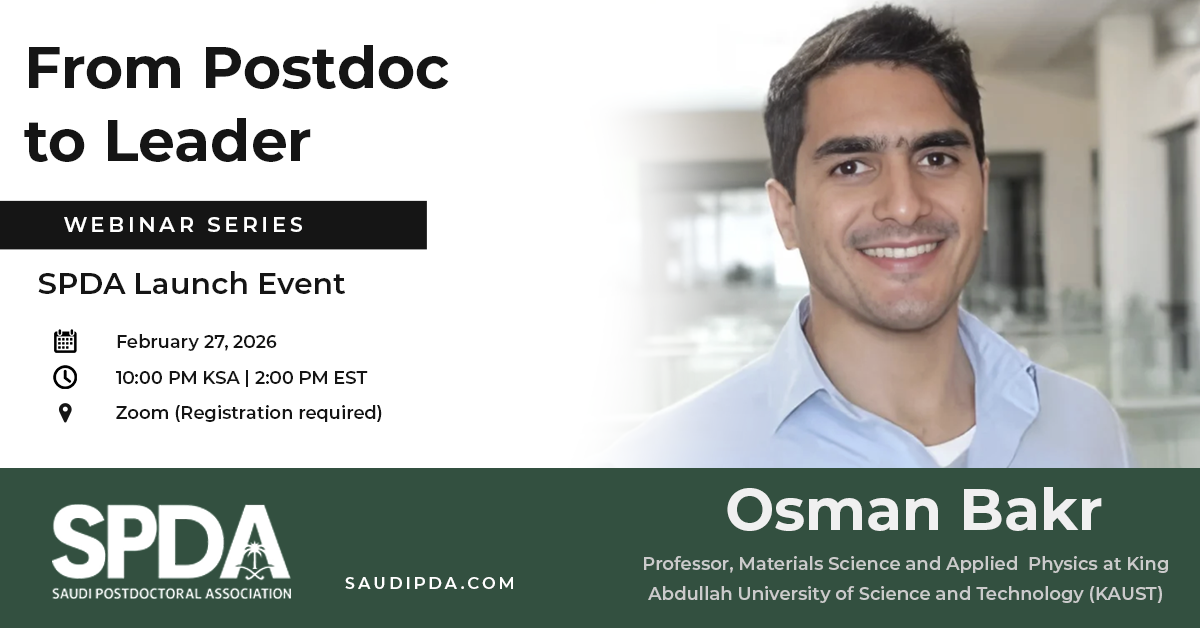
From Postdoc to Leader Webinar Series
Guest Speaker: Professor Osman Bakr
SPDA Launch Event
-
We are excited to invite you to the Saudi Postdoctoral Association (SPDA) Launch Event, which will feature the first session of our webinar series, From Postdoc to Leader, with Professor Osman Bakr (KAUST).
The event will introduce SPDA’s mission and vision, our team, the community we are building, and how postdocs can get involved. We will also share our upcoming initiatives.
Following the launch, Professor Bakr will join us for a conversation and share insights from his postdoctoral experience and leadership journey. He will reflect on lessons learned and perspectives that may be helpful as postdocs navigate their own paths. We will conclude with an open Q&A and audience discussion.
-
Osman Bakr is a Professor of Materials Science & Engineering at King Abdullah University of Science and Technology (KAUST) and Vice Provost (Fellowships, Education, Training, and Continuing Education) at KAUST.
He earned a B.Sc. in Materials Science and Engineering from MIT (2003), as well as an M.S. and a Ph.D. in Applied Physics from Harvard University (2009). His research group works on the design and synthesis of hybrid and inorganic materials, generating breakthrough applications in solar energy harvesting, photonics, and optoelectronics. He has published over 377 articles in international peer-reviewed journals and over 15 patents and invention disclosures. His group’s research has appeared in leading interdisciplinary publications such as Science, Nature Energy, Nature Photonics, Nature Nanotechnology, Journal of the American Chemical Society, Joule, and others.
Professor Bakr is a Fellow of the Royal Society of Chemistry (FRSC), a Fellow of the Institute of Materials, Minerals and Mining (FIMMM), and an Associate Editor at ACS Materials Letters (American Chemical Society). He was selected as a Young Scientist by the World Economic Forum (2016) and as a member of the Editorial Advisory Boards of ACS Energy Letters (2016) and Chemistry of Materials (2017).
He was awarded the SABIC Endowed Presidential Career Development Chair (2013); the Innovator Under 35 Award in the Arab World by the MIT Technology Review – Arab Edition (2016); The King’s Award for Inventors and the Gifted (2018); the Asian Rising Stars Lectureship (2019); the Abdul Hameed Shoman Arab Researchers Award in Basic Sciences and the Almarai Distinguished Scientist Prize (2020); the Kroll Medal & Prize by the Institute of Materials, Minerals and Mining (2021); and the Kuwait Prize by the Kuwait Foundation for the Advancement of Sciences (2022). Times Higher Education named Bakr one of the ten leading university researchers worldwide in the field of “perovskite solar cells” (2018), and Clarivate designated Bakr as a Highly Cited Researcher in both Materials Science and Chemistry.
-